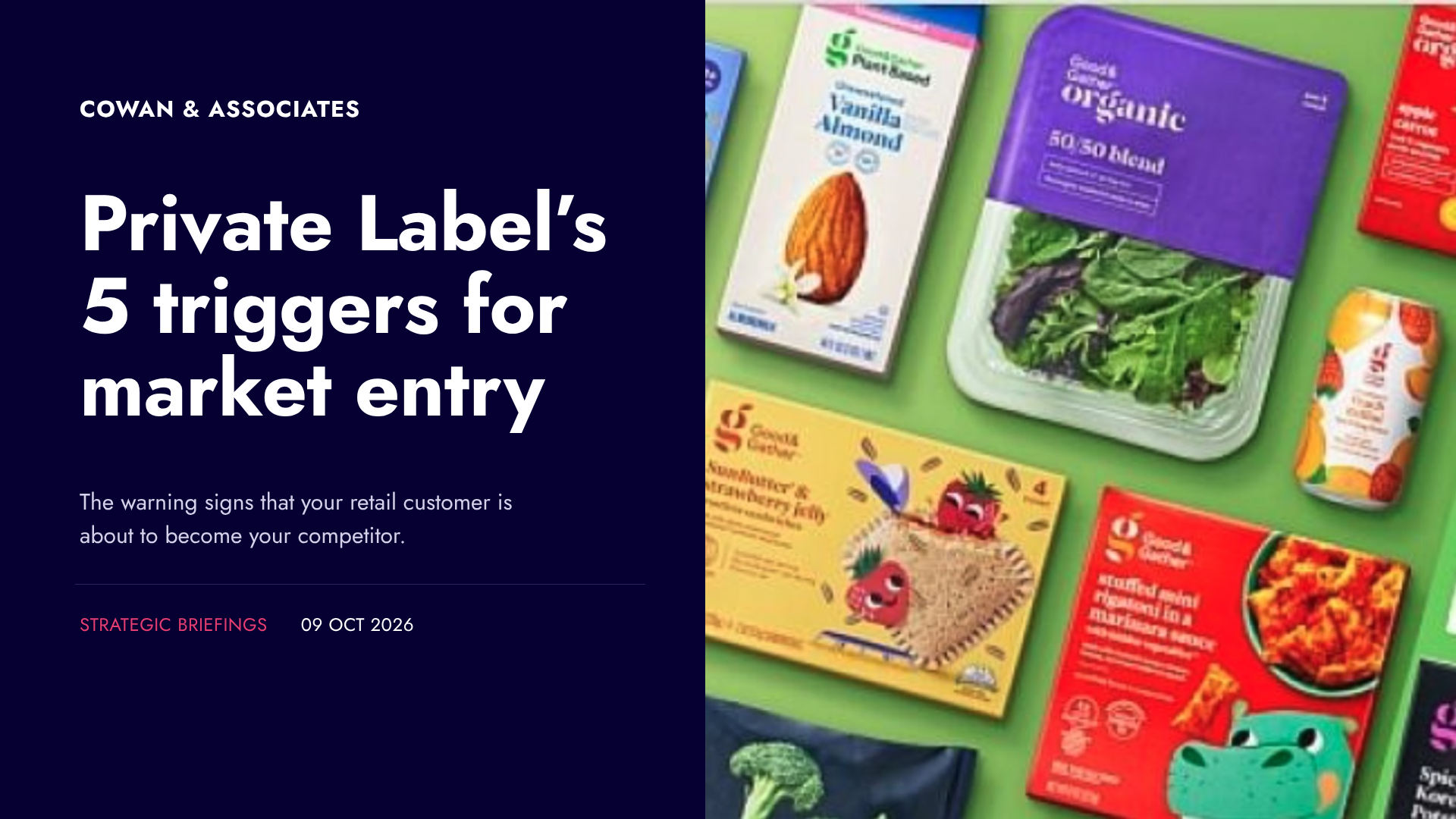
The Five Triggers: when your retailer becomes your competitor.
In September, Costco stocked Kirkland Signature Hydration in its warehouses: 40 sugar-free electrolyte stick packs at about 62 cents a serving, compared with roughly 83 cents for Liquid I.V. on Costco.com. It followed a Kirkland sparkling energy drink in March, at about 70 cents a can against roughly $1.55 for Celsius on the same shelf, and a Kirkland sports drink in June. Each launch targeted a functional category a branded leader had built and that Costco already stocked.
The easy reading is that Costco is being opportunistic. I think the pattern is more mechanical than that, and more useful to the brands on the receiving end. Retailers launch their own label in a category when the economics show up in their own data, and the age of the category has surprisingly little to do with it. Five conditions tend to coincide before a launch. All five leave traces on the brand's side of the table well before the product appears, which means the launch can be planned for rather than discovered.
A caveat up front. The five triggers come from patterns across launches in hydration, energy, mixers, and cider. They have ’t been back-tested against launch data, so treat them as a working model.
1. Repeat demand is proven in the retailer's data
Trial never triggers a launch. A retailer sees trial as a spike after a listing and discounts it accordingly. What it wants is the same households returning for the same item month after month, because repeat demand is demand it can forecast and buy against at volume. The uncomfortable implication for a challenger is that its best account scorecard, strong repeat at its biggest retailer, is also the first page of that retailer's own-label business case.
2. The price umbrella is at its widest
The best moment to enter is after the leader has paid to educate the category and while it is still holding full price. Enter earlier, and the retailer funds the education itself. Enter later and the brands are already defending share on deal, which narrows the gap the own label is meant to exploit. In Europe's six largest grocery markets, Circana's April 2026 data put 34% of branded units on promotion versus 14% of own label, showing how far that defence has already gone in mature categories. Kirkland shows the same effect on a single shelf: when Liquid I.V. drops to its $20.99 promotional price, the per-serving gap to Kirkland falls from about a quarter to about a tenth. A brand growing at full price with no promotional pressure is, from the retailer's side, sitting under the widest umbrella it will ever offer.
3. The cost base is commoditised
Own label needs a supply chain the retailer can tender. Once the ingredients are available off the shelf and co-packers can already make the product to spec, the brand's manufacturing know-how stops being a barrier. In electrolytes, the bill of materials is a handful of mineral salts and a stick-pack line. A practical early warning sits here: a buyer who starts asking unusually granular questions about COGS and who makes the product is often costing something other than your next promotion.
4. The benefit is spec-comparable on pack
This is the most underrated of the five. If the shopper can judge equivalence by reading the back of the pack, she doesn't need to trust the retailer's brand at all. Kirkland Hydration lists its electrolyte load and sweetener system per stick, so the comparison with the category leader is a two-minute read of two panels, and the retailer wins it on price.
Cider shows what happens when the benefit can't be read off a panel. Thatchers launched Cloudy Lemon Cider in February 2020, and Aldi's Taurus Cloudy Lemon Cider followed in May 2022. With nothing on the label to compare, Aldi borrowed the leader's look instead, and in January 2025 the Court of Appeal found that its packaging took unfair advantage of the reputation of Thatchers' registered trade mark, noting that Aldi had achieved substantial sales without spending on promotion. Where the benefit is taste or image, a retailer has to lean on the leader's brand cues, and registered trade mark protection can still bite. Where the benefit is a number, the retailer can match it without borrowing anything from the leader's get-up, and trade mark law gives the brand little to hold on to.
This is also why copying a variant in an established category behaves differently from entering a category a brand created. In cider, the retailer imitated a variant. In hydration and energy, it takes the whole proposition, because so much of the proposition was printed on the back of the pack.
5. Shopper language shifts from the brand to the category
The last trigger is linguistic. Shoppers stop asking for Liquid I.V. and start asking for electrolytes. Once the generic term takes over in search and in the retailer's own category naming, the brand has finished its job for the retailer: it has built a category the retailer can now name without it.
Why agents shorten the timeline
Triggers 4 and 5 have always been slow, because they depend on shoppers reading packs and changing their vocabulary. Agents remove both delays. An agent reads every specification panel in the category in the time it takes a shopper to read one, and it can be briefed by need rather than by name: electrolyte sticks, no sugar, under 70 cents a serving. That brief already rules out Liquid I.V. at list price. For any household that hands routine buying to an agent, trigger 5 becomes the default request and trigger 4 fires in every category with a measurable benefit.
The question for a brand owner shifts from whether the five conditions will coincide to how long a brand with a spec-comparable benefit can stay out of the agent's default answer. The retailers best placed to exploit that are already growing fastest: Circana's March 2026 data attribute nearly half of US private label growth to the club channel, Costco's home ground. Part 1 of this series argued that whoever owns the replenishment trigger decides what gets chosen. The retailer's label is the product that the trigger is built to choose.
What a brand owner can actually do
An own-label launch ends the story only for brands that drift. Two plays are defensible.
The first is to supply the retailer's label and keep the volume. It concedes the entry price point and protects volume, and it only works if the brand's margin structure can survive selling its own formulation at the retailer's price.
The second is to move the brand off the spec sheet before the retailer writes its own, into territory a buyer cannot write a specification for: an occasion, a ritual, a format, or a channel the retailer doesn’t control. It is the slower and more expensive play, and it has to start while the umbrella is still wide, because a brand that waits for the own-label launch before repositioning is funding the move out of a shrinking premium.
The argument that emotional connection and IP will protect the brand is weakest exactly where the benefit is measurable. Equity protects least in the categories where the shopper, or her agent, can check the claim.
The decision for Monday is narrow. For each of your top three retail accounts, score the five triggers honestly, using the retailer's view of your business rather than yours. Where three or more are already on, choose between the two plays this quarter, because the retailer will have chosen for you within the next few.
Both plays cost money, and the second costs more every year. Part 3 looks at who can still afford it, and why that list of brands is much shorter than most owners expect.
_______________________________________________________________________________
Cowan & Associates is a Dublin-based advisory firm that builds commercial decision systems, diagnostics, and intelligence for FMCG and Retail brands. It works with CEOs, founders, boards, and PE-backed leadership teams through commissioned Brand Diagnostics, Brand Clarity™ workshops, and retained Advisory mandates, drawing on 35+ years' operating experience across 900+ consumer brands.
Strategic Briefings is the firm’s published intelligence. Each briefing makes a dated call that can be proved right or wrong with public evidence, and we grade every call publicly on its stated return date, including the ones that go against us. We do this to demonstrate our pattern recognition and judgment for our clients.
The firm is led by managing partner Michael Cowan. For brand diagnostics, workshops, and advisory enquiries, email: enquiries@cowan-associates.com