
ADVISORYExperienced Operators Who Know PE’s role in FMCG.
The diagnostic names the choices, prices them against your baseline costs, and leaves the leadership team with a decision it can actually make.
THE DECISION GAPThe decision survives the meeting. It rarely survives the quarter.
Why do good decisions quietly unwind? Nothing dramatic seems wrong. The board signs off and moves to the next item. Each function reads the decision through its own plan and finds a defensible version of it. The operating calendar was set before the decision existed, and it does not move. By the second quarter the business is running the previous plan under a new name, and nobody in the building could tell you when that happened.
THE BOARDSigned off, moved on
Approval is treated as completion. The item closes, attention transfers to the next paper, and the decision loses the only forum in which it was ever whole.
THE FUNCTION HEADSEach a reasonable reading
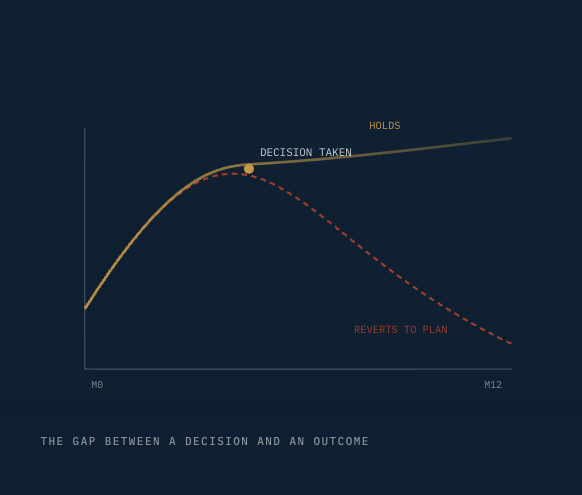
Every team interprets the decision against its own targets and constraints. No individual reading is wrong. But, together they describe three different businesses.
THE OPERATING CALENDARSet before the decision
Range reviews, promotional grids and budget cycles were locked months earlier. The decision has to fit around them, and what does not fit is deferred until it disappears.
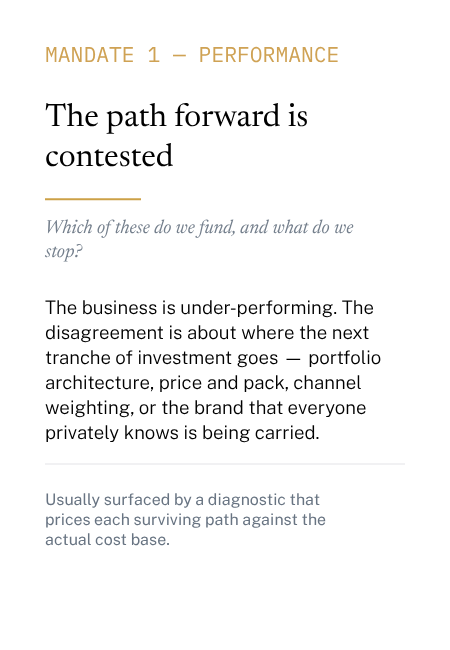
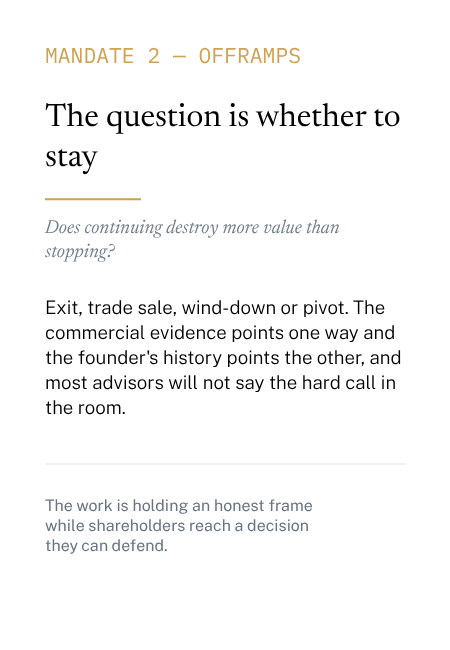
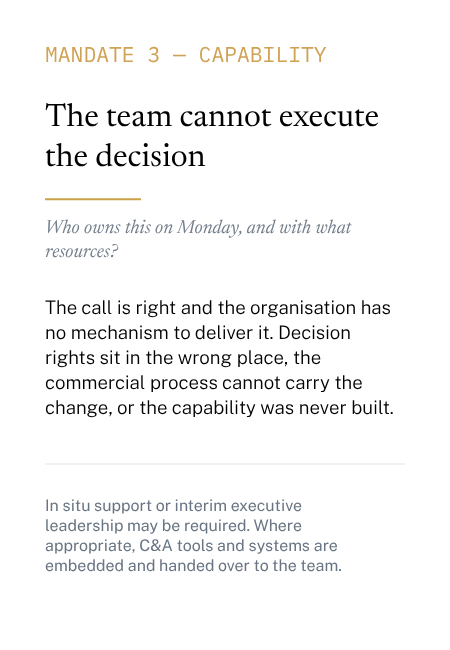
ADVISORY MANDATESClients engage C&A when one of three conditions applies, and they are not interchangeable.
Each carries a different question, a different tolerance for delay, and a different definition of a good outcome. Naming which condition you’re under determines the advisory mandate.
THE ENGAGEMENTFive stages. Each one hands the next a business that needs less help.
Each C&A engagement is designed to end. Every stage transfers something to the organisation, and the measure of the work is how little of it depends on C&A by the final quarter.
Handover
What did the diagnostic actually settle?
THE WORKThe chosen path is restated as a commercial mandate rather than a conclusion. What it forecloses is written down alongside what it opens, so that the trade-off stays visible after the enthusiasm fades.
CLIENT RECEIVESA one-page mandate carrying the decision, the sacrifices it requires, the economics attached to each, and the date by which reversal stops being cheap.
Mandate
Who owns it, and what were they holding before?
THE WORKDecision rights assigned by name. Each owner's existing load is examined, because a mandate handed to someone already at capacity is a deferral with a nicer title. The operating calendar is rebuilt around the customer cycle rather than the internal one.
CLIENT RECEIVESNamed ownership, a resourcing decision against each capability gap, and a calendar the decision can actually survive.
Execution
Is the change showing up where it was supposed to?
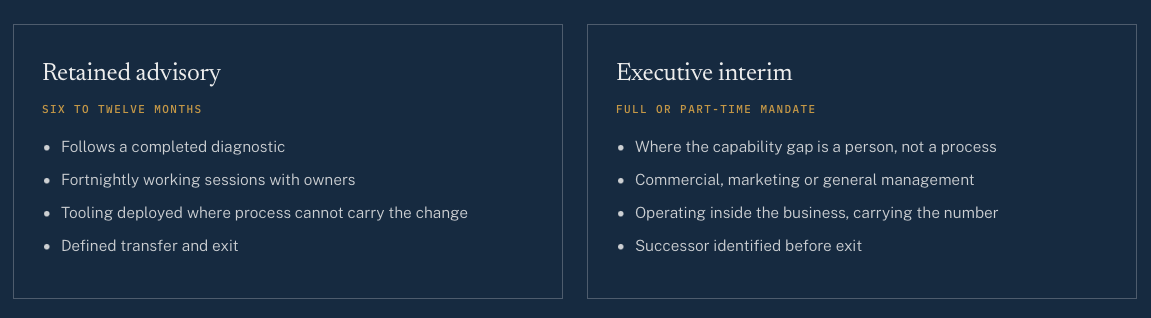
THE WORKFortnightly working sessions with the owners, not monthly updates to a steering group. Where the commercial process cannot carry the change, the tooling goes in — promotional architecture, gross-to-net discipline, range and retail standards.
CLIENT RECEIVESA working commercial process, with evidence in your own numbers showing whether the decision is delivering or needs revisiting.
Transfer
Could the team run the next one without me?
THE WORKThe method moves from our hands to theirs. The team runs the next commercial decision using the same structure, with C&A in the room but not holding the pen. Gaps that show up here are real capability gaps, and they get named.
CLIENT RECEIVESA leadership team that has run the process once under supervision, and a written account of where it strained.
Exit
What was actually built?
THE WORKA closing read against the original mandate: what moved, what did not, what the business now owns that it did not own twelve months earlier. Honest about the parts that failed, because those are the ones worth understanding.
CLIENT RECEIVESA closing assessment, the operating system running without external support, and no dependency to unwind.
THE NUMBER THAT MATTERSThe cost of the decision going unmanaged is yours, and it is usually already in your P&L.
Advisory is not priced against a day rate comparison. It is priced against what the unresolved decision is costing while it stays unresolved — and that figure comes out of your own gross-to-net, your own cost-to-serve, and your own promotional file. The diagnostic produces that cost before any advisory conversation happens.
WHERE IT HIDESPromotional investment
Mechanics repeated because they were run last year, with no read on whether they recruited anyone. Visible only when gross-to-net is built by customer rather than in aggregate.
WHERE IT HIDESPortfolio drag
Lines carried without a stated role, consuming working capital, shelf negotiation and management attention that the growth lines needed.
A retainer is straightforward to justify when it is set against a leak you can see in your own numbers. Producing that figure is the diagnostic's job, and it happens before you commit to anything.
WHERE IT HIDESDeferred decisions
The compounding cost of a choice postponed for four quarters, measured against what the same choice would have cost when it was first available.
HOW IT RUNSTerms, stated up front.
Full details discussed during a Strategic Fit Call
WHERE TO STARTAdvisory begins with a diagnostic. Then we confirm the strategic brief.
Retaining an advisor before the decision is named produces expensive drift. The diagnostic establishes what the choice actually is, prices it against your cost base, and tells both of us whether advisory is warranted. Some businesses read theirs and act without me. That is a legitimate outcome.

BRAND CLARITY BRIEFINGSDiscover what determines a brand’s success or failure.
Short, sharp reads on how consumer brands grow, stall, and exit, and what the pattern says about where the value sits.
Delivered directly to your inbox every Sunday.